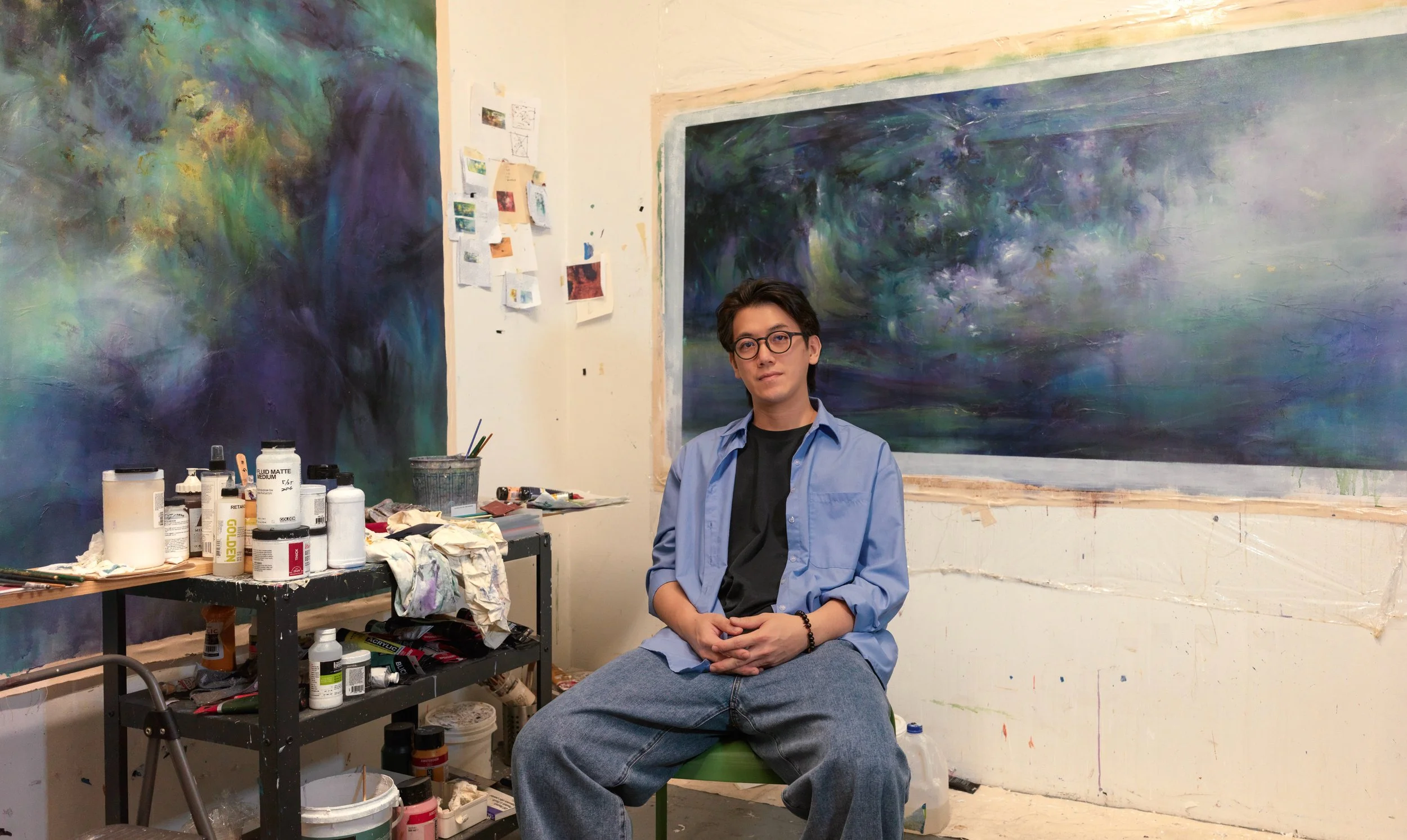
Exhibited Artist
Kan Hung-Ju (b. 1993, Taiwan) currently lives and works in New York. He earned his Bachelor’s degree from the National Taiwan University of the Arts and his Master of Fine Arts from the Massachusetts College of Art and Design. His work has featured at Harvard University, Art Taipei, and Art Central Hong Kong, with solo exhibitions in Boston and New York. His international presence includes group shows in Shanghai, London, and beyond, reflecting a trans-regional contemporary perspective.
Kan’s artistic practice is a journey of “visual tracing” conducted between memory and emotion. Instead of relying on representational narratives, Kan constructs unnamable psychological spaces on canvas through the abstract layering and dissolution of brushstrokes. These images are neither landscapes nor pure abstractions but exist in a suspended state between the two, causing Kan to drift continuously between the familiar and the unfamiliar.
In terms of methodology, his work is not a reproduction of the external world but a process of internalizing perception into rhythms and traces. Having received rigorous training in traditional Chinese painging during his time in Asia, he adheres to the Eastern principle of “sourcing from the heart while learning from nature.” By observing natural light, shadows, fragments of daily life, and foreign landscapes, he transforms these elements into internal emotional structures. The brushstrokes, layering, and dissolution on the canvas are trajectories of psychological movement rather than the mere construction of icons.
This focus on how memory is viewed resonates deeply with the cinematic language of Andrei Tarkovsky in the film Nostalghia. Tarkovsky utilized temporal image structures to collapse the boundaries between reality and memory. Similarly, Kan borrows the visual metaphor of floral motifs and employs the haziness of ink to dissolve spatial stability. This logic of spatial montage, involving the stacking and fading of color and patterns, functions as a visual temporal displacement that keeps the image in a state of flux. Ultimately, Kan’s work forms an unfixed temporal experience between landscape and non-landscape. It is not an arrival but a traversal, and it is not a representation but a becoming.
甘泓儒(1993年出生于台湾)现居纽约从事艺术创作。 2015年毕业于国立台湾艺术大学,并取得马萨诸塞艺术与设计学院美术硕士学位。其作品曾于多个重要展览中亮相,包括2019年哈佛大学史密斯中心、2021年波士顿个展、2022年台北艺术博览会、2024年纽约个展,以及2025年香港Art Central个展等。其艺术足迹亦延伸至上海与伦敦等多地的群展,展现出跨地域的当代视野。
他的艺术实践是一场在记忆与情感之间进行的「视觉的循迹」。不依赖具象的叙事,而是透过抽象、层叠与消融的笔触,在画布上构筑出一种难以被命名的心理空间。这些画面既非风景,也非纯粹抽象,而是一种介于两者之间的悬置状态,使创作者在熟悉与陌生之间持续游移。在创作方法上,他的创作并非对外在世界的再现,而是一种将感知内化为节奏与痕迹的过程。他在亚洲时期接受传统水墨的扎实训练与影响,依循东方水墨「外师造化,中得心源」的观念,观察自然光影、日常碎片与异地风景,将其转化为内在情感的结构。画面中的笔触、堆叠与消融,更接近一种心理运动的轨迹,而非图像的建构。
这种对「记忆如何被观看」的关注,深受安德烈‧塔可夫斯基(Andrei Tarkovsky)在电影《乡愁》(Nostalghia)中的影像语言产生深度共鸣。塔可夫斯基透过时间性的影像结构,使现实与记忆之间的界线逐渐崩解。他借鉴花布图腾的视觉隐喻,透过水墨中朦胧感消解了空间的稳定性。这种影像逻辑深刻影响了他的绘画:色层与花布的堆叠与消融,这种空间的蒙太奇手法如同一种视觉上的时间错置,使画面处于不稳定的状态。最终,他的作品在风景与无景之间形成一种未被固定的时间经验,不是抵达,而是穿越;不是再现,而是生成。